Skip Navigation

Posts
58
Comments
431
Joined
3 yr. ago

  • While checking on the status of legislation for my own state I found this website which seems to be tracking progress for all of them: https://pluginsolarguide.com/

  • I can see this one from bookwyrm.social and I'm definitely taking some recommendations from it!

  • I did try that, and found a bunch of lists, but not that particular one (nor can I apparently find the user moanos who created this list). Perhaps the two instances aren't federating.

    edit: this actually seems to be the case - since I can see Remy Rose's "We Don't Have To Live Like This" list from my instance.

  • Wowee

    Jump
  • We haven't found the upper limit yet, but with more research funding we can get closer

  • For some reason I can't figure out how to reach your list from https://bookwyrm.social/ but I'd suggest Murder in the Tool Library by AE Marling and the Glass and Gardens anthology if you're looking for more recommendations.

  • Yeah trees are great wherever they'll fit, and in my region you pretty much have to work not to have land return to forest. But there are a bunch of regions where shade cloths or latticework are the traditional answer to shading streets for climate/biosphere reasons. Plus people get all freaked out about tree roots messing with building foundations and underground infrastructure so not all pedestrianized streets may be suitable depending on what's below them.

    (Apologies if your second paragraph wasn't about trees)

  • For sure! In that case I think it's worth asking what will this parking lot be in fifty or 100 years, especially if we transition away from cars. Is it suitably located to host some kind of park, marketplace, sports field, or other open space, or will adding a bunch of gantries of solar panels entrench it as car infrastructure by also making it part of the energy infrastructure? Many cities need to improve density and affordable housing, and parking lots are generally a good bit of land to repurpose as they're already negligible as habitat and generally located conveniently. (This is probably less important in exurban areas and around industry).

    If we could pick suitable lots and exclude ones that make more sense as housing etc up front, this kind of installation could last a really long time and provide additional benefits. I'm actually interested to see how viable a similar arrangement would be over pedestrianized streets which get a lot of sun exposure, similar to the ones they put over canals or the shade cloths etc already used in many cities.

  • Takes more infrastructure to set panels up up high over a parking lot full of drivers than in an empty field so that delays the solar transition a bit - you likely want as few new posts/pylons in a parking lot as possible but the whole rig still has to survive some idiot in a F-650 plowing into a post without toppling and crushing a bunch of cars and shoppers. I suspect high winds might be more of an issue but I'm not a civil engineer. Throwing them in a field is a bit quicker.

    Maintenance is more of an issue too - the elevation adds some accessibility challenges. Plus, do you close the parking lot whenever people are working up there to minimize the liability/risk someone gets brained by a wrench? Parking lot operators are skittish enough of falling tree limbs that they often remove any trees from the property.

    TBH I'm happy with any new solar and it's certainly an improvement over parking lots as they stand now, plus it puts them close to the places using them which is great. But I also think expedience has a real value at this transition point.

  • If you're using a chainsaw make sure you're wearing chainsaw chaps, a face shield, gloves etc. The chaps especially can save your legs and your life when the saw kicks back (and it will at some point) - especially if you're out in the sticks and alone.

  • The community chores category is really interesting! Do you remember what kinds of work would fall into that? Or have any in mind?

  • I completely agree! I have much the same sentiment in the section "The work people take on despite the conditions and poor pay"

  • Work Reform @lemmy.world

    Looking for input/feedback on what work would look like in solarpunk settings

  • The permiculture forums have some diy guides on savonious wind turbines, I'll see if I can find some good ones. Feeding that into an off-the-shelf battery bank might be the challenging part.

  • Reticulum is a decent candidate for this (in that it's purpose-built for more than texting).

    There's a couple good beginner's introductions here:

    https://www.carstenboll.dk/reticulum-a-beginners-guide/

    https://github.com/samuk/awesome-reticulum/

    Reticulum is a whole cryptography-based network stack which feels like it was developed from the ground up out of radio networking protocols. It can run over the same LoRa radio devices Meshtastic and Meshcore can use, but it can also use ad-hoc WiFi, data radios, modems, serial lines, amateur radio digital modes, and it can even tunnel through the Internet (meaning you could set up a local mesh of LoRa radios, old personal computers and laptops, and whatever wireless routers and other networking gear you can find, connect a neighborhood together using Reticulum as the underlying network, then connect that through the internet to Reticulum networks anywhere in the world. You can write software to run on Reticulum, and it already has a bunch of programs like NomadNet which can do encrypted messaging (same goal as Meshtastic and Meshcore) but also host and view text-based web pages and I think some other stuff. In a lot of ways, this one feels like the meshnet you'd see in a scifi book, an all-encrypted network stack that allows you to just link together any old hardware you can scrape together and rebuild a decentralized version of the internet grounded in much more secure protocols. (I'll admit I straight up don't understand how a lot of this works on the network/cryptography level, it actually seems similar to Tor in some ways but I don't understand that very well either.)

  • Worst case, it could make a pretty cool sunken greenhouse if it gets enough light

  • To quote the article:

    There are still many human-powered carts in modern society: strollers, grocery carts, roller suitcases, and various utility and folding carts. However, these modern carts are to their predecessors what modern birds are to dinosaurs. They are small, often with very small wheels, and we use them for very short distances, usually inside buildings.

  • Just transporting my case of glass vials of Nitroglycerin like it's the third act of a western film.

  • Thanks! I really appreciate the thought so please don't worry about text length!

    I agree strongly on the level of separation - I think ideally the investigators should be there to do the research and build the case, but should be relying on a separate group for physical enforcement, and the community should have a separate system of restorative/rehabilitative justice which the investigative society reports to. On top of that, I think I want to convey that the investigative societies aren't a monopoly or can't monopolize an area/territory - ideally a given community has several (perhaps overlapping) options actively investigating crimes and other mysteries (not unlike having multiple newspapers all with their own investigative reporters), so they're not locked in with a particular group. (Possibly same for enforcement, I'll say more on that in a minute). I think that plus the lack of qualified immunity and other protections from consequences should help (I know licensed private detectives in some jurisdictions get some additional permissions, I might look into what that entails to see if its a better fit).

    I really appreciate you pointing out the qualification process because you're right that can be a lever for preventing scrutiny or limiting membership or otherwise used unfairly and I'm not sure how best to address it. I was actually planning to pin some of the protagonist's motivations on wanting to 'move up' from the more general crowdsourced investigations (find this lost dog, help track the course of this buried river) to the level that requires more community trust (crimes where access to private information might be accessed or where there is a victim to protect). I think qualifications or demonstrations of capability are important but also very much agree that they can be implemented maliciously and unfairly, and I'm not sure how to square that yet, aside from a separate process of audits or perhaps cross-investigations.

    As for the violence-doing side of things, thank you so much for introducing me to the concept of a consolidated Public Safety Department. I'd never heard of that before and I'm delighted to hear that it's been implemented in the real world, because I would have thought it'd be a hard sell! I think that stands an excellent chance of changing the motivations around joining up, though I'll admit I'd worry that it'd keep good candidates for fire and EMS out if they don't want to have to be cops. It'd likely be a great fit for a solarpunk society where that stigma and isolation from the community has had some time to wear away due to programs like this though.

    Over on the FA discord, there was a great conversation around the enforcer side of this triad(? of investigators, enforcers, and justice system) and some interesting points were brought up which I'll try to convey. One of the devs listed four keys of locking away the modern power of the police:

    • Civilian Panopticon - I think this is a bit of an answer to PunkIsUndead's question about what information is stored and revealed to the investigators on a case by case basis - the idea that public areas are surveilled more or less constantly at a low level (I suppose not unlike now), and most moderately dense areas have more surveillance which might be building-specific and not shared normally, or secretly. So when the investigators are looking for evidence they might ask a neighborhood for the security footage from the park or street, and then have to work with certain households or condo associations or what have you to glean more than that. I was leery about this one but I also considered that most of the scant accountability we see these days comes from regular people's cell phones, so it could very well work both ways if the community are the ones who control this information, rather than corporations hoarding and selling it. Presumably that'd extend to communications records, GPS and other similar information which is currently available if you spend a few bucks or wave a badge around.
    • Overlapping Authorities - I think this covers situations where one organization or sheriff etc is effectively answerable to no one.
    • Multiple Independent Militias - I think this applies just as well to the investigators but we were thinking kinda small with having multiple overlapping groups, I really like the idea of rotating the members of those groups (especially the designated violence-doers) through other professions. I think that is a great addition.
    • Societal Intolerance for Professional Murder

    Interestingly, there's a couple of these (overlapping authorities and Multiple Independent Militias) that kind of match the how-to-survive-as-a-dictator playbook: never let any of your armed forces get individually powerful enough to oppose you.

    As a last note, I'm quite content to write the investigators as being unarmed in this story, two of my favorites (Lt. Colombo and Hercule Poirot) both declined to carry firearms, content to let the uniforms do that work.

  • Thanks!

    your example sounds more like current day private investigators / investigative journalists, who occasionally get tasked by their community to do police investigator things

    I actually think of them that way too.

    As for information, in Marling's stories the settings are still quite high tech so more information is retained than might be ideal. I think it was stuff like GPS and similar movement records. The improvement over our present is that they don't just ask a corporation for the info because there are some apparently functional protections in place, and I think at one point they're temporary stymied when a community tells them to pound sand because the local council is concerned the investigative society has been overreaching lately. I don't have specifics in mind for the temporary powers/accesses as they won't really come up in this story but it might be equivalent to the stuff police forces just request/buy from companies today. The protagonist could just as easily be a private detective or reporter but I'll admit I do like the concept of these investigative societies and the changes they demonstrate in the setting.

  • Anarchism and Social Ecology @slrpnk.net

    Hoping to check a concept for use in fiction

  • Fuck Cars @lemmy.ml

    Any favorite articles/essays? (Especially around how cars reshaped rural places)

  • Fuck Cars @lemmy.world

    any favorite articles/essays? (especially around how cars reshaped rural places)

  • grimdank @lemmy.world

    Seems legit

  • DIY @slrpnk.net

    Question about analog voltmeters and antique telephones

  • DIY @slrpnk.net

    Looking for advice on separating layers from a rear projector TV screen

  • zerowaste @slrpnk.net

    is there any good way to put an extremely-flaking pleather jacket back into service?

  • zerowaste @slrpnk.net

    I just realized recently that our entire entertainment system is reclaimed ewaste

  • Solarpunk technology @slrpnk.net

    hoping to build a list of car parts that can be used for other things

  • DIY @slrpnk.net

    Hardcover Bookbinding and Laser Etching the Bookcloth

    movim.slrpnk.net /blog/jacobcoffinwrites%40slrpnk.net/hardcover-bookbinding-and-laser-etching-the-bookcloth-UGHW2D
  • Solarpunk @slrpnk.net

    What would you like to see in solarpunk art of ships/boats/coasts?

  • zerowaste @slrpnk.net

    The art of recycling/repurposing broken-up concrete (sometimes apparently called 'urbanite')

  • DIY @slrpnk.net

    Bookbinding a softcover book
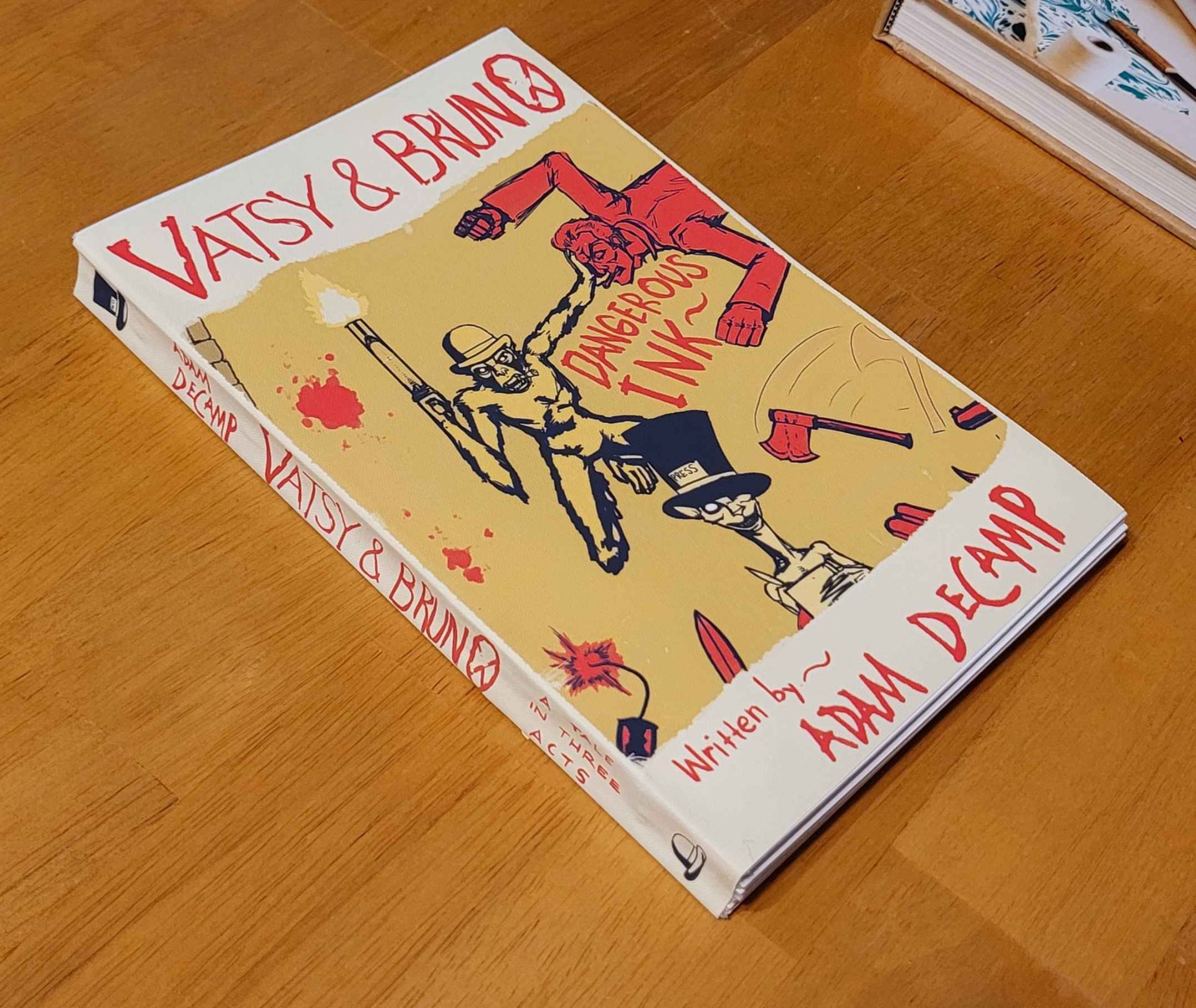
    movim.slrpnk.net /blog/jacobcoffinwrites%40slrpnk.net/a-quick-paperback-bookbinding-project-qqhaeW
  • DIY @slrpnk.net

    My first bookbinding project - a hardcopy of the Fully Automated! TTRPG Rulebook

    movim.slrpnk.net /blog/jacobcoffinwrites%40slrpnk.net/bookbinding-the-fully-automated-rulebook-odTqQI
  • Solarpunk @slrpnk.net

    Solarpunk Workshop

  • Solarpunk @slrpnk.net

    Deconstruction crew disassembling abandoned McMansions so the material can be reused - Postcard from a Solarpunk Future

    pixelfed.social /p/JacobCoffin/691779890604446248
  • Solarpunk technology @slrpnk.net

    solar concrete kiln design questions

  • Anarchism and Social Ecology @slrpnk.net

    Scrappy Capy Distro just released a new anarchist fiction zine called Harbour (one of my stories is in it)

    en.scrappycapydistro.info /harbour
  • Cooking @lemmy.world

    I made a chart of spices and their substitutions

    imgur.com /a/g9WX9sQ